Step One: Intake & Safety Check
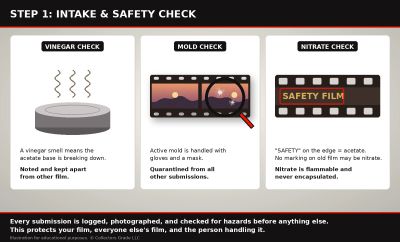
Before anything else, your film is logged, photographed, and checked for hazards. This protects your piece, our other submissions, and the person handling it.
Vinegar Check: A vinegar smell means acetate breakdown (vinegar syndrome). The piece is noted and kept apart from other film.
Mold Check: Active mold is handled with gloves and a mask and quarantined, following Library of Congress handling guidance.
Nitrate Check: Suspected nitrate film is flammable. It is handled with care, kept away from heat, and never encapsulated.
Note: photographs are for internal use only and are the property of Collectors Grade LLC
Step Two: Film Authentication
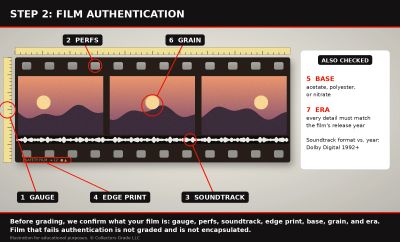
We confirm what your film actually is, whether it's a theatrical release print, a trailer, or another film format. Film that fails authentication is not graded and will not be encapsulated.
1. Format & Gauge: 8, 16, 35 or 70mm, measured and matched to the correct frame size.
2. Perforation Type: Perf count, shape, and pitch. 35mm carries four perfs per frame on each side.
3. Soundtrack: Analog optical, Dolby Digital (1992+), DTS (1993+), SDDS (1993+), checked against the release year.
4. Edge Print: Manufacturer, stock codes, and date symbols along the edge.
5. Film Base: Acetate, polyester, or nitrate. "SAFETY" edge markings confirm acetate.
6. Print Type & Image: Real film grain under magnification, not printer dots on transparency plastic.
7. Era Consistency: Every detail has to agree with when the film was supposedly made.
Step Three: Condition Inspection — The Four Checkpoints
.png/:/rs=w:400,cg:true,m)
Once it's real, we inspect its condition under backlight, raking light, and magnification across four film checkpoints. Each one gets its own sub-grade.
EMULSION: The health of the image layer itself, the gelatin that holds the picture. We look for flaking, fogging, residue, softening, chemical odor, and base chemistry.
OPTICAL: How the picture looks today when light passes through it. We look for fading, magenta shift, silvering, density, and contrast.
PERF: The sprocket holes and edges that carried the film through the projector. We look for stretching, tears, stress cracks, and edge damage.
PHYSICAL: The overall mechanical state of the piece. We look for projector rain, scratches, cinch marks, curl, warp, and creases.
Printed-in vs. real damage: Dirt or scratches carried over from the lab's printing negative show under backlight but feel smooth under raking light. Physical damage catches the raking light. We grade the difference.
Step Four: The Stability Gate
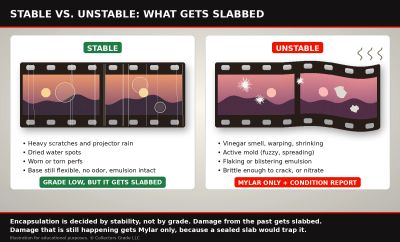
A sealed slab is a closed environment. Before we seal anything, the film has to prove it is chemically and structurally stable.
What Makes a Piece Unstable?
A scratch, a water spot, or a torn perf is damage that already happened. It won't get worse inside a slab, so the piece is stable and can be encapsulated at any grade.
A piece is unstable when the damage is still happening: the film is actively breaking down chemically or biologically, or it's too fragile to seal safely. Sealing it in a slab would trap that process inside.
Eligible for Encapsulation (Stable):
- Projector rain and scratches
- Handling marks and creases
- Minor warp or curl
- Dried historical moisture spots
- Worn or torn perfs
- Factory miscuts
A low grade reflects wear. It does not disqualify a stable piece.
Mylar Only, With Condition Report (Unstable):
- Vinegar syndrome: a vinegar smell, often with shrinking, warping, or brittleness
- Active mold: fuzzy, powdery, or web-like growth, or a musty smell
- Active emulsion failure: the picture layer is flaking, blistering, or peeling
- Severe brittleness: the film is stiff enough to crack or snap
- Nitrate film base: flammable, and never sealed in anything
Unstable pieces are returned in archival Mylar with a written condition report explaining what we found.
Encapsulation is decided by stability, not by grade. A stable piece is slabbed at any grade. An unstable piece gets Mylar only at any grade.
Step Five: Grade Assignment
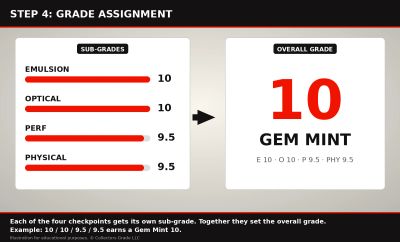
The four sub-grades (Emulsion, Optical, Perf, Physical) set the overall grade on our Film Grading Scale below.
Sub-Grade Matrix (Emulsion / Optical / Perf / Physical)
Gem Mint 10: 10 / 10 / 9.5 / 9.5
Pristine 10: 10 / 10 / 10 / 9.5
Flawless 10: 10 / 10 / 10 / 10
0.5 Addition Rule: For overall grades of 9 and below, a half-point can be added for strong sub-grades, never for pieces with major visual or structural flaws.
Step Six & seven: Archival Sealing/Encapsulation & RETURN
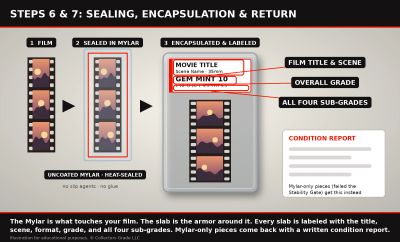
Step Six: Archival Sealing & Encapsulation
What touches your film matters more than the slab around it.
1. Mylar Sealing
Every piece is first sealed in uncoated archival Mylar (PET), in line with Library of Congress Specification 500-542: no plasticizers, no surface coatings, no slip agents. Each cell is heat-sealed along the edges with a small gap around the film, so it is held in place without being pinched or touched by heat. Nothing is ever glued or taped.
2. Slab Encapsulation
Pieces that passed the Stability Gate are then placed, inside their Mylar, into a Collectors Grade holder and sealed with their label. The Mylar is what touches your film. The slab is the armor around it.
3. Mylar-Only Pieces
Pieces that did not pass the Stability Gate stay in their archival Mylar and are not sealed in a slab. A sealed slab is a closed environment, and active vinegar syndrome, active mold, active emulsion failure, severe brittleness, or nitrate film has no place in one. These pieces are returned with a written condition report explaining why.
Why Slip Agents Matter
Many plastic sleeves are made with slip agents, chemical lubricants that keep plastic from sticking during manufacturing. The Library of Congress found the slip agent erucamide migrating through several layers of polyester and concluded amide slip agents would likely migrate onto stored objects and cause yellowing. Sealed in a slab, they have nowhere to go.
Before you buy slabbed film, ask what's inside the slab.
Step Seven: Return
Your film comes back with complete label documentation: the film title, scene, format and gauge, overall grade, and all four sub-grades (Emulsion, Optical, Perf, Physical). Pieces that went Mylar-only come back with a written condition report explaining why.
Anyone can check if it's real. We tell you its condition, backed by L.O.C. archival standards.