
CG FILM ACADEMY
Film care & Authentication:
lessons every collector should know.
How to tell if your film is real, what a condition grade actually measures, and how to store and protect your film so it lasts. Built on guidance from the Library of Congress and the National Archives.
This guide is for ungraded film: loose strips, cells
Lesson 1: What Film Is Made Of
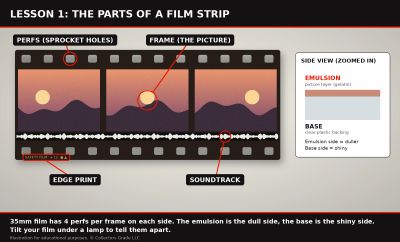
Motion picture film has two layers:
- The base: the clear, flexible plastic strip. On most film it's acetate or polyester. Very old film (before the early 1950s) may be nitrate, which is flammable.
- The emulsion: a thin layer of gelatin coated on one side of the base. This is where the picture actually lives.
Tilt your film under a lamp. The shiny side is the base. The duller side is the emulsion.
Perfs (perforations) are the small rectangular holes punched along the edges. A projector has gears with teeth (sprockets) that fit into these holes and pull the film through, one frame at a time. That's why they're also called sprocket holes.
How many perfs you should see per frame:
- 35mm: 4 on each side
- 70mm: 5 on each side
- 16mm: 1, on one or both sides
- 8mm and Super 8: 1, on one side
Lesson 2: Is It Real? Check It Yourself
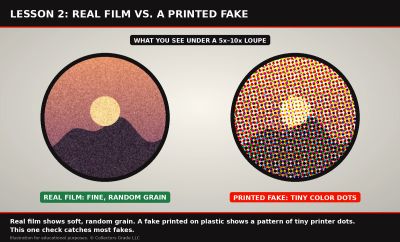
You don't need to pay anyone to tell you whether your film is genuine.
These checks take a light, a 5x–10x loupe, and a few minutes.
1. Count the Perfs
Hold your cell up to the light and count. Uneven, missing, or oddly shaped holes are a warning sign.
2. Find the Emulsion Side
Tilt it under a lamp: the base looks shiny, the emulsion looks duller. On a 35mm print, hold it with the picture upright and the soundtrack on the left, and you're looking at the emulsion side. If both sides look exactly the same, be suspicious.
3. Look Under a Loupe
Real film shows fine, natural grain. A printed fake on transparency plastic shows a pattern of tiny printer dots. This one check catches most fakes.
4. Check the Soundtrack Against the Year
- Analog optical track: the wavy line between the perfs and the picture.
- Dolby Digital: data blocks between the perforations. Didn't exist before 1992.
- DTS: a timecode track, introduced in 1993.
- SDDS: tracks along the outer edges, introduced in 1993.
A 1985 film showing Dolby Digital blocks isn't an original 1985 print.
5. Read the Edge Print
Film stock often has the manufacturer's name (like Kodak or Fuji), stock codes, and date symbols along the edge. If the edge print shows a much newer date than the film's release, it's a later print, not an original.
6. Check the Base
- "SAFETY" printed on the edge means acetate film.
- Older film with no safety marking could be nitrate, which is flammable. Handle it carefully, keep it away from heat, and don't seal it in anything.
- Polyester film is very strong and hard to tear. Acetate tears more easily.
7. Use Your Nose
A vinegar smell means the film is breaking down (vinegar syndrome). It isn't a sign of a fake, but it tells you the film is chemically unstable and needs care.
What these checks can't tell you: Authentication tells you what you have. It doesn't tell you how well it has survived. That's what a condition grade is for.
Lesson 3: What a Real Condition Grade Measures
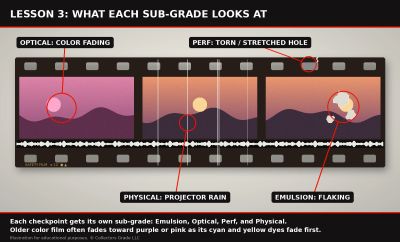
Every piece Collectors Grade grades gets four sub-grades, one for each part of the film that can wear or break down.
EMULSION: The Health of the Picture Layer
- High (9–10): Smooth, fully attached to the base, no cloudiness, no residue, no odor.
- Mid (5–7): Light surface scuffs or a slight haze, but the gelatin is solid and stable.
- Low (1–3): Fogging (a cloudy, milky look), flaking, blistering, or mold damage. On acetate film, vinegar syndrome: a vinegar smell that can lead to shrinking, brittleness, and the emulsion buckling or pulling away from the base.
OPTICAL: How the Picture Looks Today
Hold your film up to a light. Optical measures what you see: color, darkness, and clarity.
- High (9–10): Strong, true color and rich blacks. No fading.
- Mid (5–7): Some fading or a slight color shift, but the image is still strong.
- Low (1–3): Heavy color fading. Older color film often turns purple or pink as its blue-green (cyan) and yellow dyes fade first. On black-and-white film, look for silvering: a shiny, mirror-like sheen in the dark areas.
Why Emulsion and Optical are graded separately: An older color print can have a perfectly healthy emulsion and still have faded purple. That's high Emulsion, low Optical. A print in the early stages of vinegar syndrome can still look great while its chemistry is failing. That's high Optical, low Emulsion. One number can't tell you both.
PERF: The Sprocket Holes
Every time film ran through a projector, the sprocket teeth pulled on the holes. Heavy use stretches, cracks, and tears them.
- High (9–10): Clean, crisp holes that keep their original shape. No stretching, cracks, or tears.
- Mid (5–7): Light wear or slight stretching on a few holes.
- Low (1–3): Torn, cracked, or badly stretched holes, or damaged edges.
PHYSICAL: The Overall Condition of the Piece
- High (9–10): No scratches, no projector lines, still flexible, lies flat.
- Mid (5–7): A few light "rain" lines (thin vertical scratches left by a projector) or handling marks away from the main picture.
- Low (1–3): Deep scratches through the main subject, heavy rain, creases, warping, shrinking, or brittleness (stiff enough to crack or snap).
Curl vs. cupping: A gentle lengthwise curve from years on a reel (core-set) is normal. If the film curves side to side across its width (cupping), that can be a sign of shrinkage or moisture problems.
Printed-in vs. real damage: Some specks and lines were copied into the film at the lab, so they were there the day it was made. Look at your film two ways:
- Backlight: hold it up to a light and look through it.
- Raking light: tilt it under a lamp so the light skims across the surface.
Real scratches catch the raking light. Printed-in marks only show when you look through the film, and the surface stays smooth.
Base scratch or emulsion scratch? Under raking light and a loupe, a scratch on the shiny side is in the base. A scratch on the duller side is in the emulsion. If it has cut through the picture layer, that image loss is permanent.
Lesson 4: Handling Your Film
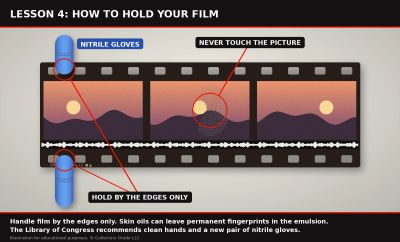
- Edges only. Never touch the picture. Handle cells by the edges.
- Wear nitrile gloves. The Library of Congress recommends a new pair of nitrile gloves with clean hands. Skin oils can leave permanent fingerprints in the emulsion.
- Dust first. Film attracts dust. Use a bulb blower or anti-static brush before anything touches the surface. Wiping film with grit on it is like using sandpaper.
- Handle as little as possible. Every handling is a chance for a scratch.
Lesson 5: Storing Your Film
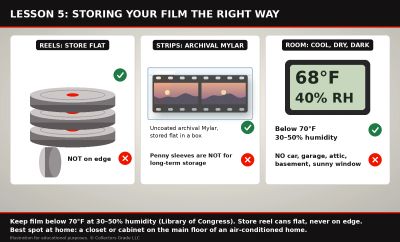
The three enemies of film are heat, humidity, and light.
- Heat speeds up every kind of film breakdown. The Library of Congress says to keep film as cool as possible and always below 70°F. Archives store film much colder, around 35°F.
- Humidity: the Library of Congress recommends 30–50% relative humidity. The National Archives targets about 35%. Too damp invites mold. Too dry can make film brittle.
- Light: constant light, especially sunlight, speeds up color fading. Keep film in the dark.
Never store film in:
- A car, even for a day
- A garage, attic, or shed
- A basement or on the floor, where water and pests can reach it
- A sunny window or next to a heater or AC vent
Best spot at home: a closet or cabinet on the main floor of an air-conditioned home. In Florida, the AC matters. Don't leave film in a room you shut off in summer.
Loose strips and cells:
- Sleeve them in uncoated archival Mylar (polyester) or another sleeve that has passed the Photographic Activity Test (PAT). Avoid PVC, and avoid sleeves that feel oily or sticky.
- Store them flat in an archival box.
- Never use tape, glue, or rubber bands on film.
Reels:
- Store cans lying flat, never standing on edge. Standing reels can warp the film and break the core.
- Use archival plastic cans and cores when you can. Old metal cans can rust.
- Wind film evenly, not loose and not too tight.
- Give it air. The Library of Congress says to move film out of non-ventilated containers into ventilated ones. Trapped gases from aging film speed up its own decay.
Lesson 6: Warning Signs and Quarantine
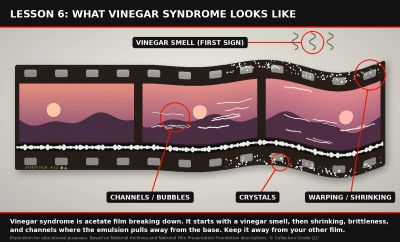
Check your film a couple of times a year.
MOLD
- Looks like: White or gray fuzzy spots, or thin web-like patterns on the surface.
- Smells like: Musty or earthy, like a damp basement.
- Why it matters: Mold feeds on the gelatin that holds the picture, can permanently etch it, and its spores spread to nearby film.
VINEGAR SYNDROME (acetate film)
- First sign: a vinegar smell. Archivists use A-D Strips (acid-detecting strips) to measure acidity inside a container.
- Later signs: shrinking, brittleness, warping, crystals or white powder on the film, and channels or bubbles where the emulsion pulls away from the base.
- Why it matters: The acid it gives off speeds up the same breakdown in healthy film stored next to it.
NITRATE FILM (mostly before the early 1950s)
- Look for no "SAFETY" marking on the edge, yellowing, stickiness, or an acidic smell.
- Why it matters: Nitrate is highly flammable and should not be stored in a home. Contact a film archive or specialist.
COLOR FADING
- Looks like: Older color film turning purple or pink.
- It can't be reversed, but cool, dark, dry storage slows it down.
Found a problem? Quarantine it.
- Separate it right away, in its own box, away from the rest of your collection. The National Archives recommends storing deteriorating film separately from film in good condition.
- Never use the same gloves or cleaning pads on problem film and healthy film.
- Wear gloves and a mask (N95 preferred) when handling moldy film. Work somewhere ventilated and wash your hands afterward.
- Don't wipe or brush mold off indoors. That spreads the spores.
- Fix the cause. Mold means the storage was too damp.
Lesson 7: Cleaning Loose Strips and Cells Before Submitting
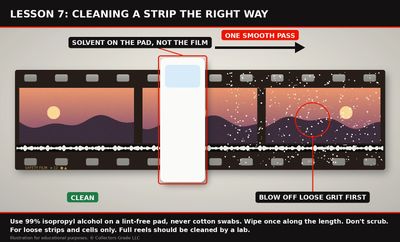
Lesson 7: Cleaning Loose Strips and Cells Before Submitting
Using the wrong cleaner can permanently streak or damage film. If you're not sure, don't clean it. Send it as is.
What to use:
- A film cleaner made for motion picture film, such as PEC-12 (Photographic Solutions confirms it's safe for motion picture film).
- Lint-free pads, such as PEC*PAD.
- Solvent-resistant gloves (not thin latex), and a face mask. Work in a well-ventilated area.
Never use:
- Film cleaner on magnetic sound film or film with a magnetic sound stripe.
- This method on film with torn or damaged perfs.
- Water-based cleaners or household glass cleaners.
How to clean:
1. Work on a clean, dust-free surface.
2. Put a drop or two of cleaner on the pad, never directly on the film. The pad should be lightly damp.
3. Wipe gently in one direction along the length of the strip. Don't scrub back and forth.
4. Check the pad often and move to a clean spot at the first sign of dirt or grit, or it can scratch the film.
5. Let the cleaner fully evaporate before sleeving the film.
6. Use a fresh pad for each piece, and never reuse one from film that smelled of vinegar or showed mold.
Full reels should be cleaned by a lab or specialist.